
 HDM
HDMHigher education talks a great deal about belonging. We talk about community, engagement, student voice and inclusion. Yet belonging is often framed as something relational or pastoral, something that sits alongside learning, rather than within it.
Work on Being, Belonging, Becoming began with a simple question: what actually matters to students in their lived experience of university?
Research by Meehan and Howells (2018) into first-year transition identified three core influences on student experience:
- The academic staff students work with
- The nature of students’ academic study
- The feeling of belonging.
Building on this foundation, my work has explored three interrelated dimensions that shape lived experience:
- Being – feeling recognised, legitimate and seen
- Belonging – feeling relationally and structurally included
- Becoming – feeling that one is developing intellectually and personally, with a sense of trajectory.
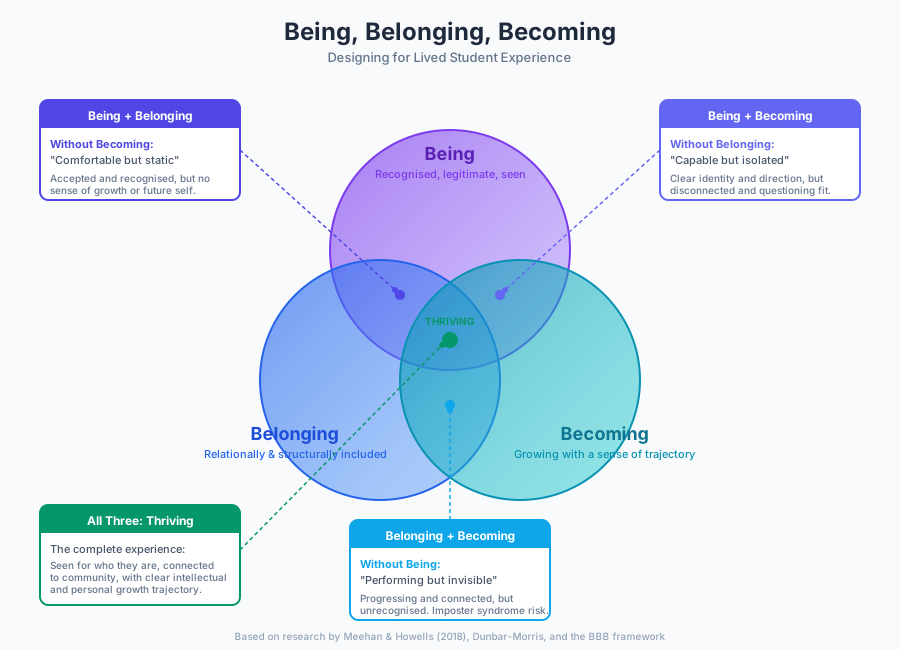
These are not abstract ideals. They are shaped, strengthened or undermined through everyday design decisions: how courses are structured, how assessment is organised, how expectations are communicated, how personal tutoring is enacted, and how services and staff interactions are experienced.
Belonging is Structural
One of the most important insights from this work is that belonging is not simply an emotion. It is a structural outcome of curriculum and assessment design.
Belonging can be eroded by:
- assessment overload and bunching
- incoherent credit accumulation
- invisible norms and expectations
- fragmented modularity
- inconsistent tutoring
- unstructured flexibility.
When students struggle to understand expectations, feel disconnected from staff, or experience their learning as fragmented, belonging becomes fragile. This is particularly true for students navigating transition, including international students, mature learners, and those engaging in more episodic patterns of study.
If belonging is structural, then it must be designed.
From Satisfaction to Lived Experience
The Being, Belonging, Becoming (BBB) survey emerged as a way of moving beyond traditional satisfaction metrics. Rather than asking whether students are satisfied, it explores whether they feel:
- academically legitimate
- connected to staff and peers
- supported in their intellectual development
- able to see a future trajectory.
The survey has been developed and piloted across multiple institutions, but its value lies less in the instrument itself and more in what it makes visible. It shifts conversations from opinion to evidence and from generalised assumptions to lived experience. It also supports co-creation, enabling staff and students to work together on evidence-informed redesign.
In practice, institutions have used BBB data to redesign personal tutoring, clarify expectations around teaching and assessment, structure peer interaction and address hidden norms that disproportionately affect particular groups of students.
Being, Belonging and Lifelong Learning
As higher education engages more fully with lifelong learning, flexible provision and increasingly complex student lives, these dimensions become even more significant.
Lifelong learners may return after significant gaps, balance study with work and caring responsibilities, or experience discontinuous patterns of participation. In such contexts:
- Being becomes about legitimacy across life stages.
- Belonging becomes about connection in episodic participation.
- Becoming becomes about sustaining intellectual trajectory despite interruption.
Designing for lifelong learning is not simply a question of modularisation or flexible delivery. It is a question of how we sustain being, belonging and becoming across different modes and tempos of engagement.
A Design Question
The point of Being, Belonging, Becoming is not to add another survey to institutional dashboards. It is to inform design.
Selected BBB items can be used as pulse surveys, embedded in curriculum review, or used to stimulate collaborative design conversations. The goal is not measurement for its own sake, but thoughtful, inclusive redesign.
If we are serious about inclusion, student success and lifelong learning, we must move beyond policy aspiration and attend to the architecture of lived experience.
Further Reading
- Dunbar-Morris, H. and Clegg, A. (2025). Unveiling Student Experiences: The Being, Belonging, Becoming Survey. National Teaching Repository. Report. doi.org/10.25416/NTR.28380686.v1