 HDM
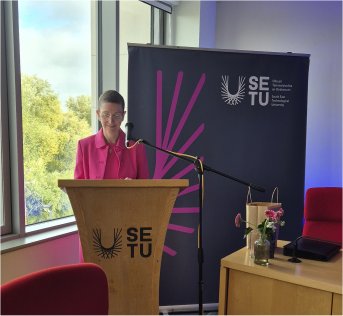
HDMThis is the text of the welcome address I gave at the Guidance Counsellor Information Day on the 22nd of September 2026 at South East Technological University.
Good morning, everyone, and welcome.
Thank you for joining us here in Carlow. I know many of you have travelled some distance this morning – from Wexford and Waterford, from Kilkenny and Laois, from Kildare, Wicklow and Tipperary – and I know that September is not a quiet month in a guidance counsellor’s calendar. So, thank you for giving us your time.
I’ve already learned one important thing since arriving in Ireland. My new title is Chief Academic Officer. Which makes me, I’m told, the CAO. In a room full of guidance counsellors, I realise there is only one CAO that really matters – and it isn’t me.
So, I promise to keep the acronyms to a minimum.
You are among the most trusted people in a young person’s life, at one of the most consequential moments in it. Long before a student sets foot on one of our campuses, they have usually sat down with one of you – in a school office or in private practice – and talked through what they enjoy, what they’re good at, what worries them, and what they might become.
So, you know our future students before we do, and SETU cannot do its job well without you. Today is about giving you current, useful information to share with your students – and, just as importantly, about hearing from you.
Let me tell you briefly who I am, because my own route here matters to what I want to say.
I did not take a straight line. All of my degrees were in Linguistics (or the Science of Language) at the University of Toulouse. If you had told the teenager choosing her subjects at school in the North East of Scotland that she would one day be responsible for the academic life of a university – let alone a technological university in the South East of Ireland – I think she might have laughed. Or blanched.
What has followed has been more than twenty years in Higher Education – at UCAS, the UK’s equivalent of the CAO, so I’ve seen admissions from the inside; at the universities of Bath, Bradford and Oxford; as Dean of Learning and Teaching at Portsmouth; and most recently as Provost and Pro Vice-Chancellor Academic at the University of Buckingham.
Through all of that, my work has asked one question: what helps students succeed – not just get in, but stay and thrive? That has taken me into research on teaching, on assessment, and above all, on belonging.
Alongside that, I recently held a Visiting Fellowship at the University of Oxford, working on lifelong learning and the part universities will play across longer and more changeable careers. One conclusion has stayed with me. The decisions students make at seventeen or eighteen are important – but they are no longer decisions that define an entire lifetime. That work led to a leadership toolkit I’ve published, called Designing Curriculum for Real Student Lives. The title was deliberate. Education has to adapt to students, rather than expecting students to adapt to systems designed for a different era.
The framework I keep coming back to is a simple one: being, belonging and becoming. Being – that each student is recognised as an individual. Belonging – that they are connected to other people and to their learning. Becoming – that someone is invested in who they will grow into. Hold on to that last word, becoming. I’ll come back to it.
So why SETU? Throughout my career, I’ve been drawn to universities with a strong sense of place and purpose. Universities transform individual lives, but they also transform regions – and I believe the South East has enormous potential. For many years, talented young people from this region felt they had to leave to find the opportunities they wanted. Some will always choose to go elsewhere, and that’s as it should be. But our ambition is that those who want to stay can have an outstanding university experience right here, and graduate into rewarding careers.
SETU is an ambitious university. In the four years since it was established, SETU has brought together two institutions with more than half a century of history each, across campuses in Waterford, Carlow, Wexford, Kilkenny and Wicklow, with more than 18,000 students. This month, alongside more than 3,000 new first years, we welcomed our very first students in Veterinary Medicine, in Pharmacy, and in Home Economics.
My job is to lead the academic mission of the university: the quality of our programmes, how we teach and assess, and how we support every student to succeed – whichever campus they study on, and whatever route brought them to us.
I have been in post for only a matter of weeks, and my first priority is to listen – to staff, to students, to employers, and to people like you. I’ll tell you shortly where I intend to put my energy. But first I’d like to spend most of our time on the question I suspect you are being asked more than any other.
It goes something like this. A student sits down in front of you, or a parent rings, and they say: “What’s the point of doing that course if AI is going to do that job?” Or: “Which subjects should I pick, so that I don’t get replaced?”
For a long time, guidance could rest on a reasonable assumption: that the world of work a young person was preparing for would look broadly similar by the time they got there. Professions changed, of course – but slowly, and you could usually see the changes coming. You could look at a student’s strengths and interests, look at the careers that fitted, and plot a sensible route from Leaving Cert subjects, to a CAO choice, to a first job – and you did it well.
That assumption is now under serious strain, so, let me be plain with you. I cannot tell you which jobs will exist in 2045. Nobody can. A young person choosing their Leaving Cert subjects this year could still be working in the 2070s.
But we are not entirely in the dark. The evidence already tells us three things.
The first is that Ireland is particularly exposed. The Department of Finance estimates that around 63 per cent of Irish employment is in occupations that are highly exposed to AI – a little above the average for advanced economies. And the share of Irish job advertisements that mention AI has nearly trebled in a little over two years.
The second is that exposure is not the same as replacement. In many of those roles, AI is more likely to change the work than to remove it – taking over some tasks, and making people more productive at others.
The third matters most for the young people you advise. The earliest effects are appearing at the very start of careers. Researchers at Stanford, using US payroll data for millions of workers, found that by this summer, employment of 22- to 25-year-olds in the most AI-exposed occupations was about 19 per cent below where it would otherwise have been.
That didn’t happen through mass redundancies. It happened because employers hired fewer young people. Meanwhile, in jobs where AI supports people’s work rather than automating it, employment has held steady or grown – especially for experienced workers. Here in Ireland, the Department of Finance is already seeing weaker employment growth in the sectors most exposed to AI – and it has warned that entry-level and junior roles are where the effects will show first.
Why is that? Well, AI is very good at codified knowledge – the kind of thing you can write down in a textbook. It is much less good at tacit knowledge – judgement, context, the know-how you only get from doing something, getting it wrong, and doing it again. And the entry-level job has traditionally been where young people built exactly that kind of knowledge. Those first jobs are where beginners become experts.
So, here is the key point. The challenge for this generation is not so much that there will be no work. It’s that the traditional ways into work are changing – and young people will need to arrive with more experience, more judgement and more adaptability than we have ever expected of a new graduate.
What does that mean for how you advise? Now, I don’t presume to tell guidance counsellors how to do your job – you know your students, and you know the entry requirements, far better than I do. But let me offer five principles from where I sit, and I’d welcome your challenge on them over the course of today.
One: interest matters more, not less. It’s tempting to steer students towards whatever looks “AI-proof”. I’d resist that. The young people who thrive will be the ones who like learning – and people keep learning in things they find meaningful. A student who chooses a subject they care about, and does well in it, is building both their points and their appetite for learning. A student who grinds through a subject they dislike because someone told them it was future-proof is building neither.
Two: keep doors open, and build the foundations that AI can’t supply. Maths – and I know the Higher-or-Ordinary conversation is one you have every year – still opens more doors than almost any other subject. Strong reading and writing matter enormously, perhaps more than ever. And here’s why, in an age of AI.
You cannot judge an answer to a question you couldn’t begin to tackle yourself.
The valuable person is the one who knows enough to see when the machine is wrong. AI doesn’t make knowledge redundant. Knowledge is what allows you to use AI well, rather than be used by it.
Three: look for the human, the practical and the accountable. By that I mean work that depends on care, on trust, on physical presence and skilled hands, or on someone being professionally accountable for a decision. Think of health and social care, teaching, engineering and construction, the skilled trades and apprenticeships – and yes, veterinary medicine and pharmacy. Though I’m aware which courses we’ve just launched, nothing is immune – but in these areas AI is far more likely to be a tool in someone’s hand than a substitute for them.
Four: choose for experience, not just content. If entry-level jobs are thinning out, then experience has to be built into education itself. When students compare courses, encourage them to ask: Will I work on real projects? Is there a placement? Will I work with employers, on real problems, with real people? That has long been a strength of technological universities – and it is about to matter more than ever.
Five: the first choice is not the last. As I said earlier, choices made at seventeen or eighteen no longer define a lifetime. Today’s school leavers will learn, work, retrain and learn again. So, there is no single wrong door. Ireland’s qualifications framework – PLC courses, apprenticeships that now run up to degree level and beyond, higher certificates, ordinary and honours degrees, and the new tertiary degrees that begin in a further education college – means that a young person who starts on one route can move to another. That is a reassuring message for an anxious student, and for an anxious parent.
And there’s a fairness point here that matters for our region. When the traditional ways into work thin out, the young people who lose most are those with the fewest family connections to professional work. That makes access routes such as HEAR and DARE, and the support around them, more important, not less.
Let me come back now to that word I asked you to hold on to: becoming.
Perhaps the question we ask young people needs to change. “What do you want to be?” assumes a fixed destination – a single job, in a world that is offering fewer of those. A better question might be: “What do you want to become – and where will you learn best?” Or: “What problems do you care about? What do you enjoy getting better at, even when it’s hard?” A sixteen-year-old can answer those today – and the answers will still make sense, even if the job titles change.
One last word on AI, because it’s already in the classroom. Your students are using it, and many of you will be following the debate about AI and the new Leaving Cert assessment components. Universities face the same challenge. The danger isn’t that students use AI. It’s that they let it do their thinking – and leave with a qualification, but not the capability it’s meant to represent. So perhaps the question to ask a student isn’t “Did you use AI?” but “Could you explain this without it?”
So, what will SETU do about it? Let me tell you where I intend to put my energy – and you can hold me to it.
I want every SETU student to learn to use AI well – critically, creatively and ethically. In every discipline, because every graduate will work alongside it.
I want us to look hard at how we assess, so that an SETU award certifies what a graduate can genuinely do – their knowledge, their judgement and their skills – and not what a tool produced on their behalf. Assessment has been at the heart of my own work for many years, and it will be a priority here.
I want to strengthen learning through work – placements, live projects, and partnerships with employers across the region – so that our graduates leave with the kind of experience the entry-level job used to provide.
I want our pathways into, through and beyond SETU to be clear and flexible – whether a student comes to us straight from school, studies part-time, or returns later in life to retrain.
And I want belonging to stay at the centre, because in a time of uncertainty the students who do best are the ones who feel known, supported and connected – which is exactly where Dr Laura Keane will pick up in a few minutes.
And I’d like to ask something of you in return. Tell us what you’re hearing. What are your students worried about? Which courses do you find hard to explain, and what information would make your job easier? You hear the questions long before we do, and I want SETU to be a university that listens to guidance counsellors – and acts on what it hears.
Let me finish with a poem I often read to new students at matriculation. It’s by Emily Dickinson, and it’s only eight lines long.
The going from a world we know
To one a wonder still
Is like the child's adversity
Whose vista is a hill,
Behind the hill is sorcery
And everything unknown
But will the secret compensate
For climbing it alone
For climbing it alone. That, I think, is the question underneath every conversation you have with a student about their future – whether or not they ever put it into words. The world behind their hill is less predictable than the one most of us climbed into. We can’t pretend otherwise, and we needn’t panic. Our job is to help young people make choices grounded in who they are, to build foundations that will last – and to make sure that none of them has to climb alone.
When I read that poem to new students, I tell them that they won’t be alone at university. Today I’d say something slightly different to you. You are often the first people to walk up that hill with them. At SETU, we want to be there at the top to meet them – and to keep walking with them from there. I’m very much looking forward to doing that together.
Thank you.