 HDM
HDMIn my previous blog post, Language Matters, I argued that the success of the Lifelong Learning Entitlement depends not only on funding and pedagogy, but also on communication. This led me to ask a deceptively simple question: what should we call the people it is designed to serve?
UNESCO describes a learner, someone acquiring knowledge in formal, non-formal, or informal settings across the whole education spectrum, and in the Higher Education sector we distinguish a student, someone enrolled within a formal educational institution. The distinction is useful, but the Lifelong Learning Entitlement sits awkwardly between the two. Participants are formally enrolled and credit-bearing, yet many will not identify primarily as students.
On a recent podcast, a colleague at South East Technological University (SETU), Dr Helen Murphy, described something refreshingly direct her institution had done: it asked its adult learners what they wanted to be called.
I have spent some time this year looking at how universities describe the people who learn within them, and the SETU story turns out to be the rule, not the exception. Across 152 university websites in the UK and Ireland, every single one uses both “student” and “learner”, but with no shared convention for when. “Student” dominates everywhere; no institution I looked at uses “learner” for even a third of its mentions. But the balance shifts in a telling pattern: technological and post-1992 institutions, whose intake looks least like the traditional 18-year-old-on-campus model, use “learner” noticeably more than research-intensive ones. Russell Group sites sit around 4%. Ireland’s technological universities sit around 16%. Nobody has agreed what any of it means, how it feels, or how it affects the people the websites are meant to inform.
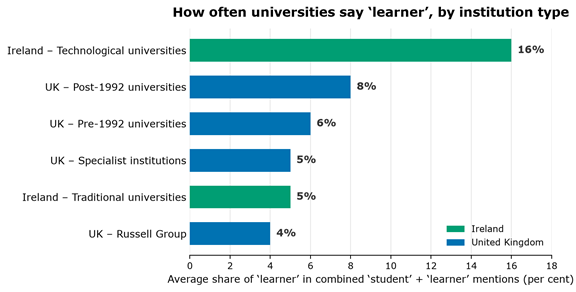
Average ‘learner’ share (per cent) across 152 UK and Irish university websites, by institution type. Source: harrietdm.com interactive term analysis, June 2026.
Which sent me to the OED, as a linguist by original background, out of curiosity about which of these words we actually had first. The answer surprised me. “Learner” is the oldest of the lot by centuries, Old English, pre-1150, from leornian, “to learn.” It is not a modern softening of “student”; it is closer to the original word for the role, and it has stayed remarkably neutral across a thousand years, at ease equally with a monastery novice, a foreign-language beginner, or someone on a provisional driving licence. “Pupil,” by contrast, arrives in English in 1531 from Latin pupillus, literally “little orphan, little ward”. It carries dependency built into its root, which sits oddly if you are applying it to a 50-year-old returning to study. So “student“, the word most of us reach for as the neutral default, was in Britain specifically a university word for four centuries, before it was casually applied to schoolchildren; the OED notes the schoolchild sense was “rare in British use before the mid-20th century”. Which is exactly the split I suspect most British readers of a certain age remember, without ever being told it: you were a pupil at school and only became a student when you arrived at university.
Interestingly, “scholar” has its own quiet history here: it is Old English too, and for centuries meant nothing grander than “schoolchild”. A sense the OED confirms has died out everywhere in English except Scotland and Ireland. The word itself, though, drifted upward over the same centuries into a term for a highly educated or expert person – which I read (this is my own inference from the two dated senses, not the dictionary’s own editorial framing) as “scholar” earning, over a thousand years, the kind of respect its schoolchild sense never had. That is a happier accident of etymology than I could have hoped for.
None of the three, it turns out, was built for the person this policy moment is actually trying to describe. Someone whose engagement with higher education is serious, recognised, and credit-bearing, but not continuous. Someone who studies around work, caring responsibilities, and an established career. Someone who may pause for several years before returning.
That is why, in a longer piece I am developing on the Lifelong Learning Entitlement, I have started using a different term: the lifelong scholar. Not a label anyone has to adopt for themselves – most people will still think of themselves as students, or learners, or simply as someone going back to study – but a design question aimed at institutions: are we building courses, credit systems and support for someone whose engagement is real but episodic, or only for someone whose life looks like an 18-year-old’s?
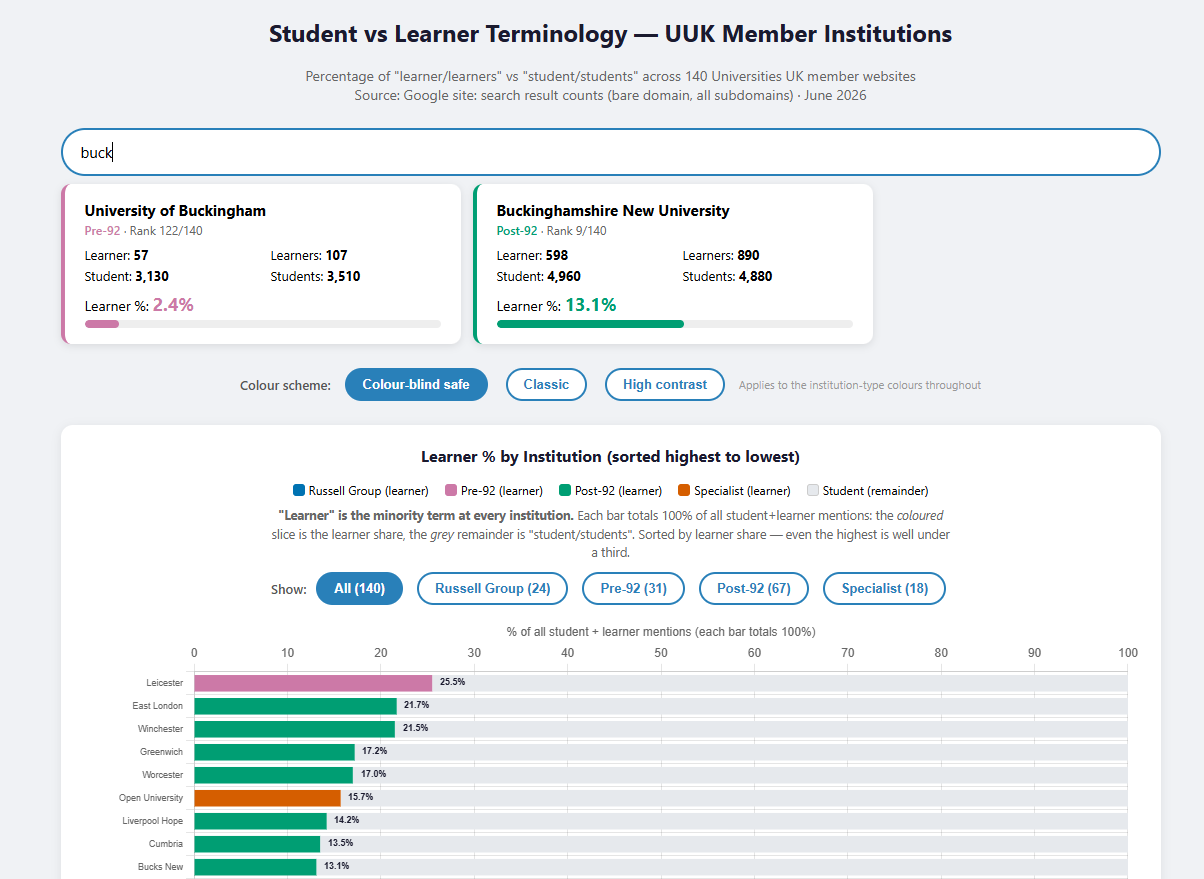
If you want to see where your own institution sits in the data, you can explore the interactive comparisons across all 152 institutions – for Ireland and for the United Kingdom (each link opens the interactive tool). Search for your own institutional website and see which terms it uses, and how often.
—–
Further Reading and References
OED Online, Oxford University Press, revised 2024 https://www.oed.com/dictionary
Interactive term analysis (Ireland and the United Kingdom): https://harrietdm.com/usedterms/ie-terms.php and https://harrietdm.com/usedterms/uuk-terms.php
UNESCO: