 HDM
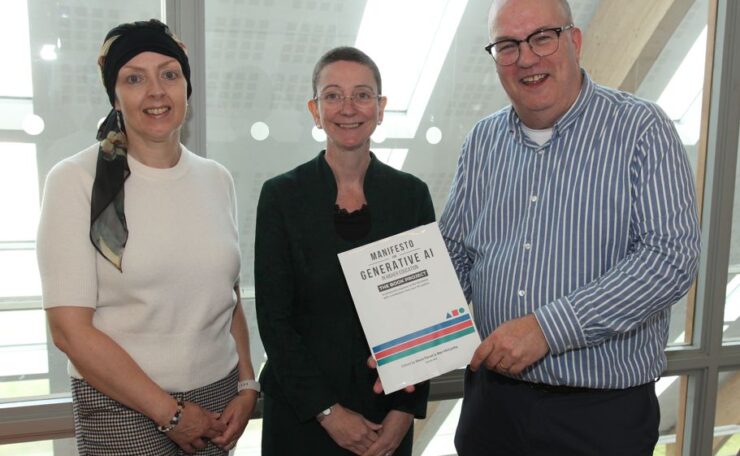
HDMThis is the text of the launch address I gave for the Manifesto for Generative AI in Higher Education: The Book Project on the 24th of September 2026 at South East Technological University.
If you would like to purchase the book, the link to it is here.
Good afternoon everyone.
As Deputy President and Chief Academic Officer, it is my great pleasure to welcome you to the launch of Manifesto for Generative AI in Higher Education: The Book Project.
I would like to begin by congratulating our editors, Hazel Farrell and Ken McCarthy, and to acknowledge the remarkable community of contributors who have helped create this volume. More than forty authors have come together here in what is a genuinely collective endeavour, and I think that spirit of collaboration shines through every page.
I would also like to recognise some of those whose voices help frame and enrich this conversation, including Leigh Graves Wolf, Tom Farrelly, and Sue Beckingham, whose contributions and reflections help situate this work within a much wider dialogue across higher education.
What I particularly love about the manifesto is its description of itself as “a living reflection on teaching, learning, and technology in an age of abundance.”
The phrase “living reflection” is important. Living things grow. Living things evolve. Living things change. And change is exactly what this book asks us to engage with.
It creates space for us to reflect, to discuss, to debate and, perhaps most importantly, to question. It reminds us that we are not reading a rulebook or a final verdict. Rather, as the manifesto itself says, it is an invitation to think, to question, and to act with intention.
We are living through a profound shift in higher education. The manifesto describes us as standing “at a threshold between what learning has been and what it might become.”
I think that is exactly right.
We are in a liminal space. And liminal spaces are rarely comfortable. They are filled with uncertainty. Established assumptions are challenged. Old certainties give way before new possibilities.
Yet they are also spaces of creativity, imagination and transformation. And to move through such a space requires courage.
It requires courage from educators redesigning learning and assessment.
It requires courage from institutions making decisions amidst uncertainty.
It requires courage from students and scholars who are learning to navigate tools that will inevitably shape their futures.
One of the recurring themes throughout this book is that higher education must respond not with fear, but with imagination and integrity. That resonates strongly with me. Academic integrity remains fundamental. Our responsibility is not simply to teach people how to use these tools. It is to help them use them ethically, critically and responsibly. Academic integrity is not a barrier to innovation; it is what makes innovation trustworthy.
I was particularly struck by the manifesto’s emphasis on design.
As David Hopkins reminds us, thoughtful design shapes the future.
As Damian Gordon argues, prompting is pedagogy.
And throughout the book there is a consistent reminder that our focus should not simply be on the products that emerge from learning, but on the thinking, judgement, reflection and growth that occur during the learning process itself. Deep learning, not surface learning. Understanding, not merely output.
One phrase that stayed with me long after I had finished reading was “orchestrated authorship”, introduced by Clióna Moynihan.
The idea is both simple and powerful.
In a world where AI may contribute words, suggestions, structures and ideas, authorship does not disappear. Rather, it evolves. The author still provides the vision. The author still exercises judgement. The author decides what stays, what changes, what matters, and what ultimately represents their thinking. The responsibility remains profoundly human.
As someone who has spent a lifetime in education, that idea speaks to me.
I think of it like a conductor standing before an orchestra. The conductor may not play every note, but they shape the interpretation, bring voices together, set the direction, and remain responsible for the performance as a whole. The music only becomes meaningful through that human judgement, intention and creativity.
And perhaps that is the opportunity before us.
Not to surrender our agency to technology, but to orchestrate it wisely.
Not to replace human thought, but to deepen it.
Not to diminish education, but to reimagine it.
So, thank you to Hazel Farrell, Ken McCarthy, and all the contributors for creating a work that is thoughtful, provocative and generous in its ambitions. Thank you all for joining us this afternoon.
I hope this book continues to spark conversations, challenge assumptions, invite debate and encourage courage.
And, borrowing from the spirit of orchestrated authorship, I hope that together we can make some wonderful music.