 HDM
HDM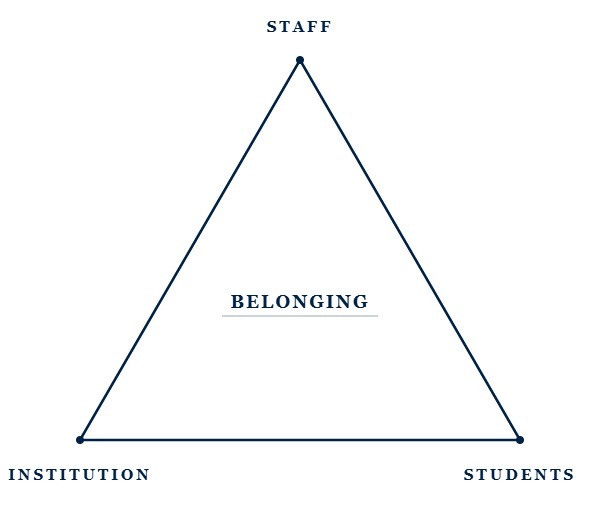
Belonging has become one of the most frequently discussed concepts in Higher Education.
We know that it matters. Students who experience a sense of belonging are more likely to engage with their studies, persist through challenges and achieve positive outcomes. Unsurprisingly, many universities now include belonging within their strategies, enhancement plans, access and participation plans, and student experience initiatives.
But the more I read and speak about belonging, the more I find myself asking a slightly different question:
Can universities create belonging on their own?
The answer, I think, is no.
Universities clearly have a role to play. Curriculum design, assessment practices, personal tutoring, induction activities, physical spaces, and opportunities for interaction all influence whether students feel welcomed, recognised, and included.
Yet recent discussions across the sector suggest that belonging is often experienced through things that are much harder to pin down directly. Much harder to produce.
Research has described belonging as emerging through relationships, trust, care, recognition, and small moments of connection. Students often describe belonging not as a result of a programme or intervention, but as a feeling that develops through interactions with staff, peers, and wider communities.
This creates an interesting challenge.
Universities are increasingly interested in measuring belonging. We survey it, track it and seek to improve it. Yet some of the factors that contribute most strongly to belonging are precisely those that are hardest to quantify:
A student remembers the lecturer who noticed they were struggling.

They remember the peer who invited them into a study group.

They remember a conversation that helped them feel that they belonged academically.
These experiences matter, but they do not always appear neatly in a dashboard.
One framework that captures this complexity well is the Being, Belonging, Becoming (BBB) framework.
The framework recognises belonging as critically important, but places it within a wider understanding of student experience. Students need to feel recognised and legitimate (Being). They need to feel connected and included (Belonging). They need to feel that they are growing and moving towards a meaningful future (Becoming).
Importantly, all three dimensions are shaped through interaction.
- Being is not something an institution can simply provide.
- Belonging is not something that can be delivered, top-down, through a single initiative.
- Becoming is not something that happens in isolation.
All three emerge through relationships between students, staff, and communities.
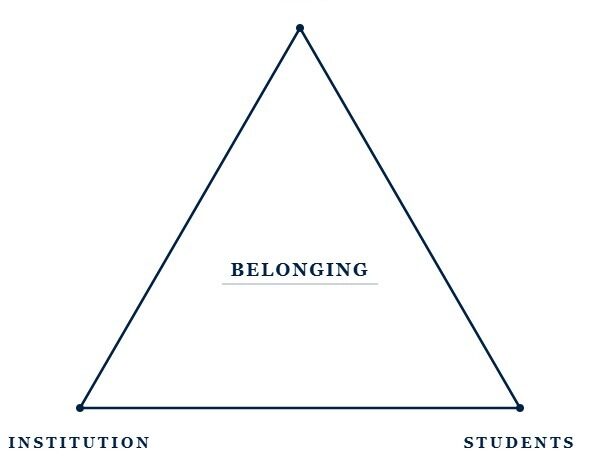
This suggests that belonging is best understood not as something institutions create for students, but as something they create in partnership with them.
That distinction matters.
If that is right, then the role of the university is not to manufacture belonging. It is to create the conditions in which belonging can flourish.
That means:
- designing opportunities for connection.
- making expectations clear.
- ensuring students feel recognised and valued.
- creating spaces where students can participate, contribute and influence.
- listening carefully to students’ experiences, particularly when those experiences challenge our assumptions.
Perhaps the most important lesson is that belonging cannot be delegated to a single team, initiative or survey.
It is created every day through curricula, teaching, support, community, and relationships.
Universities can do a great deal to nurture belonging.
But they cannot create it on their own.
Belonging is co-created, and that may be precisely why it matters so much.
Further Reading
- Akinbode, H. (2022). A Sense of Belonging: What It Means for Higher Education Institutions. King’s College London Behavioural Insights Team Blog. Available at: blogs.kcl.ac.uk/behaviouralinsights/2022/01/12/a-sense-of-belonging-what-it-means-for-higher-education-institutions
- Centre for Higher Education Research and Scholarship (n.d.). Sense of Belonging Research. Imperial College London. Available at: www.imperial.ac.uk/education-research/our-work/sense-of-belonging
- Dunbar-Morris, H. and Clegg, A. (2025). Unveiling Student Experiences: The Being, Belonging, Becoming Survey. National Teaching Repository. Report. doi.org/10.25416/NTR.28380686.v1
- Garraway, E. and Down, J. (2022). Re-defining Belonging: Whose Call Is It? Wonkhe. Available at: wonkhe.com/blogs/re-defining-belonging-whose-call-is-it
- Meehan, C. and Howells, K. (2018). In Search of the Feeling of “Belonging” in Higher Education: Undergraduate Students’ Transition into Higher Education. Journal of Further and Higher Education, 43(10), pp.1376–1390. Available at: doi.org/10.1080/0309877X.2018.1490702
- Thomas, L. (2012). Building Student Engagement and Belonging in Higher Education at a Time of Change. What Works? Student Retention & Success Programme. York: Higher Education Academy. Available at: www.advance-he.ac.uk/knowledge-hub/building-student-engagement-and-belonging-higher-education-time-change-final-report