
 HDM
HDMHow the Being, Belonging, Becoming framework can help surface hidden assumptions in programme design
One of the questions I am often asked about the Being, Belonging, Becoming (BBB) framework is whether the approach can be taken with particular groups of students. For example, international students, mature students, or those studying part-time or alongside work.
The short answer is yes. In fact, the BBB survey can be especially useful when we want to understand the lived experience of students whose participation in higher education does not match the assumptions built into many of our programmes.
What matters, however, is how we choose to use it. This is not about running another large institutional survey. It is about using carefully chosen questions to surface hidden expectations and to inform thoughtful redesign.
Why belonging can feel fragile for some students
Belonging is often discussed in general terms, but for some students it can be particularly complex.
For international students, for example, belonging is rarely just social. It is also academic and structural.
It involves:
- understanding what is expected in an unfamiliar academic culture
- feeling that staff are approachable
- feeling able to participate in academic dialogue
- navigating unfamiliar systems
- balancing study with visa, financial, or cultural pressures
In many cases, students are performing belonging, while still unsure whether they really fit.
If we want to support them effectively, we need ways of understanding those experiences that go beyond satisfaction scores or headline metrics.
This is where the BBB framework can help.
What the BBB survey is designed to explore
The Being, Belonging, Becoming framework emerged from research into what really matters to students during transition into university. Further investigations have focused on three dimensions:
- Being: feeling recognised, legitimate, and understood
- Belonging: feeling relationally and structurally included
- Becoming: feeling that one is developing and moving forward
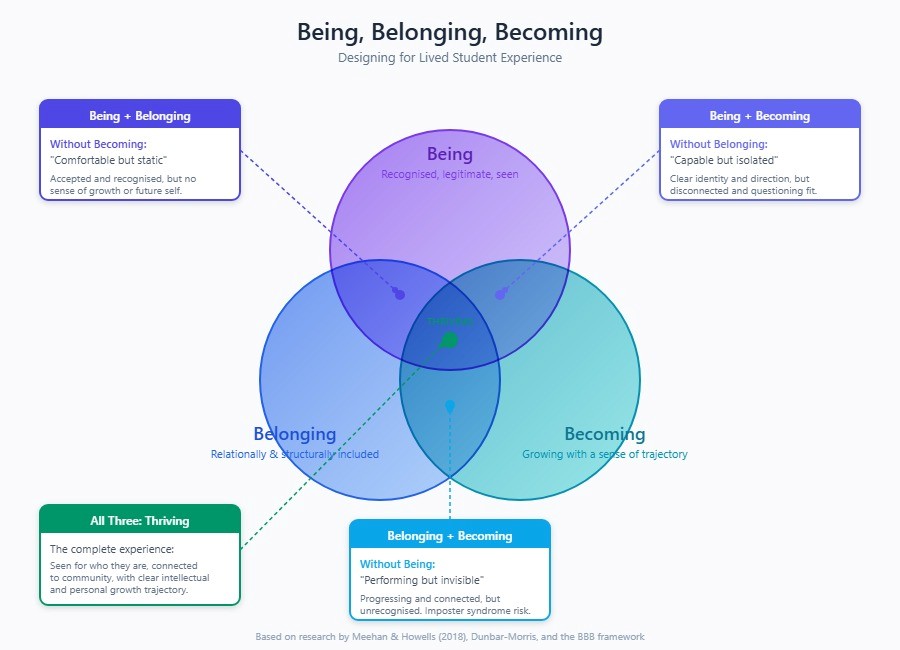
The survey that developed from this work was later piloted across many institutions, but the important shift is conceptual rather than procedural.
It moves us away from asking whether students are satisfied, and towards asking:
- Do students feel that they belong academically?
- Do they feel connected to staff and peers?
- Do they feel that their studies provide progression?
For students studying in a new country, in a second language, or alongside work or caring responsibilities, these questions can be particularly revealing.
Looking for hidden expectations
When BBB items are used with a specific group of students, the aim is not to prove that something is wrong.
It is to ask where our design assumes an idealised type of student rather than a student living the reality of study.
For example, responses to items such as:
- “I have a clear idea about the aims of my course”
- “Most academic staff are approachable”
- “I feel connected to other students”
- “I feel like I am a member of a learning community”
- “My personal tutor helped me understand difficulties settling in or settling back in”
can reveal where expectations are implicit rather than explicit.
International students, for example, may report uncertainty about academic norms, or hesitation in approaching staff, not because they lack ability, but because the rules of the environment are unfamiliar.
Seeing those patterns allows course teams to ask design questions rather than simply offering more support.
Using BBB as a pulse survey
There is no need to use the full survey to gain useful insight. In many cases, a short pulse approach works well, and often works better.
For example:
- select six to ten items aligned to being, belonging, and becoming
- run the survey early in the semester
- disaggregate responses for particular groups
- discuss the results in programme teams
- make small, visible adjustments
The value lies not in the dataset itself, but in what it prompts us to change:
- Clarifying assessment expectations.
- Building more structured interaction with staff.
- Making informal rules more explicit.
- Designing opportunities for connection, rather than assuming it will happen.
I would say students do not need more surveys. They need responsive design.
From measurement to redesign
The BBB framework is most useful when it becomes part of a cycle:
- Ask focused questions
- Look for patterns in lived experience
- Identify hidden assumptions
- Adjust programme design
- Ask again
Used in this way, it can help us understand differences in experience between groups of students without reducing those differences to deficits.
It also helps shift the conversation from: “Why don’t these students fit?” to: “What are we assuming in our design?”. That is often where the real work begins.
Invitation
Colleagues who are interested in using BBB in this way might consider:
- piloting a small set of items with a particular cohort
- adapting wording to context while keeping the core dimensions
- comparing responses across programmes
- using the results as a starting point for curriculum discussion
Please get in touch with me if you would like to discuss the use of the Being, Belonging, Becoming framework.
The survey itself is only a tool.
The aim is to understand lived experience well enough to design learning environments in which more students can genuinely thrive.
Further Reading
- Dunbar-Morris, H. and Clegg, A. (2025). Unveiling Student Experiences: The Being, Belonging, Becoming Survey. National Teaching Repository. Report. doi.org/10.25416/NTR.28380686.v1