 HDM
HDMWhat happens when curriculum is designed for continuity, but students’ lives are not?
Across Higher Education, there is growing emphasis on lifelong learning, modular provision, and more flexible pathways into and through study.
At the same time, many of our curriculum and assessment designs still assume something quite different: that students are present, available, and able to engage in consistent ways across a semester, term, or programme.
That assumption is increasingly difficult to sustain.
Students are balancing work, caring responsibilities, financial pressure, and complex lives. Their engagement is often uneven, interrupted, or episodic. They may step away and return. They may be present some weeks and not others. They may not always feel confident participating in the ways that we expect.
We often respond by adding flexibility or support around existing structures. But this risks missing the point. The issue is not only flexibility. It is design.
From flexibility to coherence
If we take lifelong learning seriously, the question is not simply how we accommodate different patterns of engagement. It is whether our curricula and assessment are designed in ways that remain coherent when engagement is not continuous.
Many current approaches depend on continuity:
- sequential learning that is difficult to re-enter
- tightly clustered deadlines that assume stable availability
- participation expectations that depend upon confidence and presence
- assessment that rewards consistency, rather than capability.
These designs can work well under ideal conditions.
But they are often fragile.
They depend upon students being able to engage in particular ways, at particular times, and with particular levels of confidence and stability. When those conditions are not met, participation becomes more difficult than it needs to be.
Designing for variability
What would it mean to design differently?
A starting point is to treat variability in student engagement as normal, not exceptional.
That shifts the questions we ask:
- What happens if a student misses part of a module?
- How does a student re-engage after absence?
- Where does participation depend upon confidence or prior experience?
- What is assumed, rather than made explicit?
These are not questions about lowering standards. They are questions about whether our designs are unnecessarily fragile.
Introducing a practical approach
During my Visiting Fellowship, I have been refining and testing a practical approach to curriculum and assessment redesign, working with senior leaders and institutional teams.

This has led to the development of a toolkit designed specifically for leaders who are supporting curriculum change in the context of lifelong learning.
The toolkit is based on a simple, but often overlooked, starting point:
We need to design not for the students we imagine, but for the students who are actually there.
The toolkit is designed to move quickly from insight to action. It brings together:
- prompts to surface hidden assumptions about students embedded in curriculum design
- ways of using evidence to understand how programmes are experienced
- a set of complementary design principles, including Being, Belonging, Becoming; Universal Design for Learning; co-creation; and authentic assessment for learning
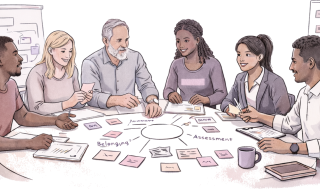
- a structured, collaborative method for redesign using charrettes
- a practical template to develop and test one focused, implementable intervention.
The emphasis is not on large-scale redesign, but on identifying high-impact, achievable changes that improve coherence, participation, and progression in realistic conditions.
Robust, not just flexible
A useful way of thinking about this is in terms of robustness.
Some curriculum designs work well only when everything goes to plan. These are fragile.
Others continue to support participation and progression even when engagement is uneven or disrupted. These are more robust.
The aim is not to remove challenge, but to ensure that curricula and assessment remain coherent under the conditions in which students are actually studying.
A leadership challenge
Curriculum redesign of this kind is not only a pedagogic task. It is a leadership challenge.
It involves:
- questioning established practices
- working across disciplinary and organisational boundaries
- using evidence in more deliberate ways
- creating space for collaborative design with students and staff.
The toolkit is intended to support that work, particularly in the context of current reforms linked to lifelong learning and modular provision.
A different starting point
Lifelong learning will not be realised simply by adding new routes into existing systems.
It requires us to reconsider how those systems are designed.
If students are to engage across the life course, often flexibly and intermittently, then curriculum and assessment need to be robust to those realities.
Not as an exception. As a starting point.
You can access the toolkit here: www.harrietdm.com/toolkit
Further reading:
https://advance-he.ac.uk/membership/member-benefit/he-horizons/edition/three