 HDM
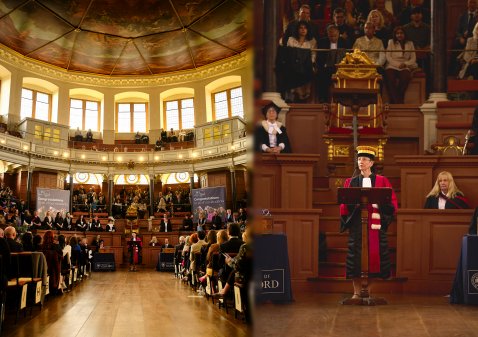
This is the speech I was delighted to give recently at the Award Ceremony in Oxford’s Sheldonian theatre, for Oxford Lifelong Learning:
I recently came across a poem by Rosemerry Wahtola Trommer called The Teacher, and I would like to begin with a few lines:
“In the garden of wisdom,
she did not step in as head gardener.
Instead, she tended her own planting.”
I think that image speaks powerfully to what you have all achieved.
You are not students who arrived empty, waiting to be filled.
You arrived already carrying full lives.
Careers, families, responsibilities, and experience.
What you needed was not someone to take over your learning, but people who would work alongside you, and trust you with your own.
The poem continues:
“She showed me how to weed
the stories we tell ourselves.”
For many of you, that will feel familiar.
Because returning to study, or studying alongside everything else in your life, often means pushing past those internal voices:
“I am too old for this.”
“I am too busy for this.”
“I do not belong here.”
Making space for a new identity as a student takes real courage.
And all of you have shown that.
The poem goes on:
“how inner spaciousness
is the richest soil for growth.”
Many of you have had to create that space deliberately, sometimes against the odds.
In the evenings, at weekends, in moments carved out from busy lives.
You have balanced study with work, with caring responsibilities, with everything else that makes up a full life.
And you have done so at different stages of life, achieving a wide range of awards. Certificates, diplomas, and degrees.
That is something to be recognised and celebrated.
The poem continues:
“She did not do the tilling for me.
Inquiry became my hoe.
She offered questions free as rain water.”
The most important thing you leave with today is not simply knowledge.
It is the habit of inquiry. The confidence to ask questions, to explore, to think differently.
During my time as a Visiting Fellow at Oxford Lifelong Learning, I have been exploring a simple question: How do we design learning that works not just in principle, but in reality?
As part of that work, I have been developing a toolkit to support universities to design learning for real student lives.
It is grounded in the experiences of students just like you.
Students whose learning fits around work, responsibility, and change.
Students whose journeys are not always linear or continuous.
And it asks a simple question: Are we designing learning for the lives students actually live?
Because lifelong learning is not an abstract idea.
It is what you have done.
It is learning that is sometimes paused and resumed.
Learning that fits around change.
Learning that is not always neat, but is always meaningful.
And I say that not only as an academic leader, but from my own experience.
My own path has not been linear. I have changed my area of expertise and the countries in which I have studied and worked. I have built my career step by step, through different roles and opportunities. I have ‘planted my own garden’ if you will.
In that sense, I am also a lifelong learner.
The poem moves towards its conclusion:
“And when it was time to sow,
from her own rows she gathered seeds.”
Your tutors have done exactly that.
They have shared their knowledge, their scholarship, their experience.
But, as the poem reminds us:
“She did not do the planting.
She handed the seeds to me.”
The seeds may be given.
But it is you who do the growing.
The garden you grow from here will be yours too.
And you have not done this alone. You have been supported by staff, by family and friends, and by one another.
We know that the world you move into is one where change is constant.
Careers will shift.
Roles will evolve.
Opportunities will emerge in ways you may not yet expect.
In that context, your greatest strength is not simply what you know.
It is your capacity to learn, to adapt, and to begin again.
So, as you leave here today, I hope you do not think of this as the end to your education.
Instead, I hope you see it as something more powerful.
Proof.
Proof that you can do this.
That you can navigate complexity.
That you can make learning work in the context of a full and demanding life.
And that you can continue to grow, again and again.
Congratulations on everything you have achieved, and on everything still to come.
To finish with the words of the poem:
“In the garden of wisdom,
she did not step in as head gardener…
She handed the seeds to me.”