HDM
HDMBelonging is in the news again.
Recent commentary from Wonkhe has highlighted how students who do not feel they belong often report that many other aspects of university life are failing to meet their expectations. Their research suggests that students who report not belonging are, in effect, experiencing a fundamentally different institution. At the same time, recent HEPI articles have explored how belonging is experienced differently across diverse student populations and how institutions can ensure that students feel they matter.
This renewed attention is welcome. Belonging matters.
For a number of years, I have been working with students and colleagues to understand and strengthen belonging within Higher Education. I have increasingly championed the view that belonging should not be considered in isolation. Instead, we need to think about three interconnected dimensions of the student experience: being, belonging, and becoming.
As I have argued elsewhere, students need all three.
A student may feel that they belong socially, but lack confidence in their academic identity. Another may be succeeding academically while feeling isolated from their peers and institution. A third may feel connected and supported but lack a sense of future direction or personal growth.
None of these represents a thriving student experience.
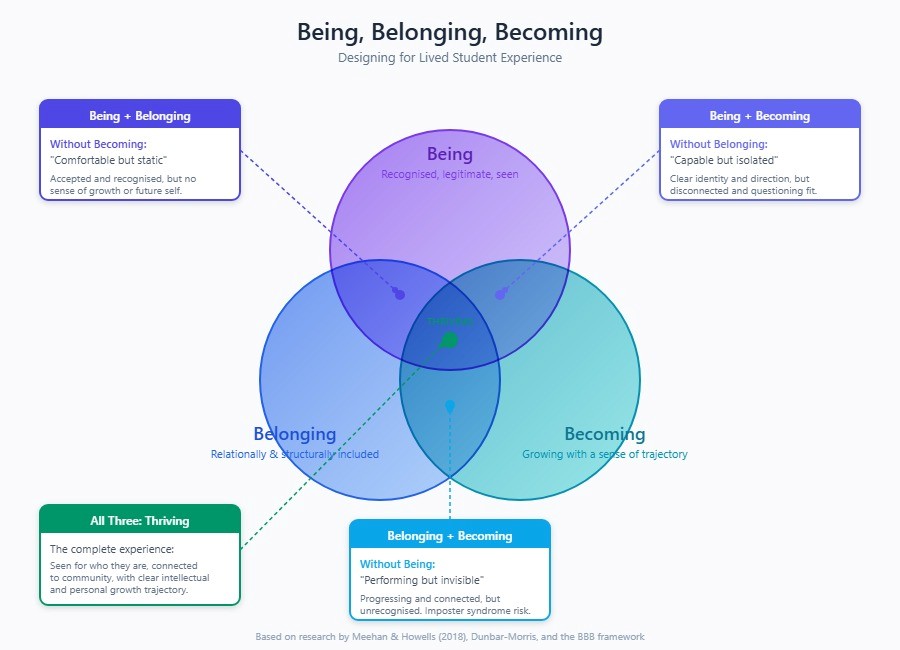
This is why the Being, Belonging, Becoming framework matters. It encourages us to think holistically about students’ lived experiences and to recognise that successful participation in higher education is about more than social integration alone.
Why does belonging matter? Because students tend to do better when they experience meaningful connection with staff and peers, understand what is expected of them, and feel able to engage with the opportunities and support available to them. Research consistently links belonging with engagement, wellbeing, academic success, and continuation. As David Gilani and Liz Thomas wrote in their handy literature review in February 2025:
“From improved academic performance (Veldman, Meeussen and van Laar, 2022), engagement (Zumbrunn et al., 2014), mental wellbeing (Kahu, Thomas and Heinrich, 2022), and retention rates (Gopalan, Linden-Carmichael and Lanza, 2022), student belonging is arguably central to them all.”
But belonging is also complex.
Recent scholarship highlights the different ways students understand belonging, influenced by factors such as social capital, fit and cohesion, inclusion and exclusion, and connection to academic and wider university communities. There is also a growing debate about whether institutions should focus on belonging or on helping students feel that they matter.
For me, there is a risk that we become distracted by terminology.
Whether we call it belonging, mattering, connection, or engagement, the more important question is this: what are students telling us about their experiences, and how do we respond?
This is where the Being, Belonging, Becoming survey has proved valuable. Rather than assuming what students need, it enables institutions to explore how students experience relationships with staff, connections with peers, learning, support, and personal development. The aim is not simply to measure satisfaction, but to understand the conditions that enable students to thrive.
Ultimately, belonging matters because students matter.
The challenge for institutions is not simply to talk about belonging, but to use what students tell us to co-create curricula, services, and environments that support their being, their belonging, and their becoming.
That is where meaningful change begins.