 HDM
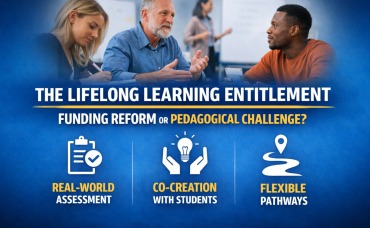
HDMThe Lifelong Learning Entitlement is not just a funding reform. It is a pedagogical challenge.
As the Lifelong Learning Entitlement (LLE) moves closer to implementation, the sector risks treating it as a technical or financial exercise. That would be a mistake.
I have previously written about the funding implications of the LLE, particularly for accelerated and less traditional providers, and about the risks of failing to remove structural inequities. But funding alone will not deliver the change the LLE demands.
If the LLE is going to work in practice, we must rethink curriculum design, pedagogy, and assessment through the lens of today’s students.
Even those students officially labelled “full-time” are balancing study with paid work, caring responsibilities, commuting, and rising living costs. Many others return to higher education later in their education journeys to retrain or upskill, and much more often alongside employment. Designing for an imagined, fully available student no longer reflects reality.
As I have argued elsewhere, flexibility cannot simply mean putting everything online. Nor can it mean lowering academic expectations. Students value interactive, purposeful learning that makes time with peers and academic staff genuinely worthwhile, and that connects learning to real-world contexts, rather than passive content consumption.
The LLE also challenges us to revisit modularisation and credit accumulation. Bite-sized, credit-bearing study may be essential for many students. But modularisation done badly leads to fragmentation and assessment overload. Fewer, larger modules (for example 30 credits) open up opportunities for more authentic assessment, less duplication, and deeper engagement.
There is no single institutional model for responding to the LLE. But there is a shared challenge. The traditional higher education model, designed for a small and relatively homogeneous student population, is no longer sufficient.
If the sector is serious about lifelong learning, we must be serious about the pedagogical work that underpins it. In particular, this means taking up some difficult but necessary challenges:
- Designing authentic, real-world assessment that reflects how knowledge and skills are used beyond the university.
- Co-creating learning and assessment with students, including offering structured choice rather than uniformity.
- Building flexible pathways that support engagement, progression, and belonging without diluting academic standards.
The LLE may not be the sector’s salvation. But if we fail to engage with it thoughtfully and creatively, it risks becoming a missed opportunity that students simply step around.
Previous Writing:
https://www.hepi.ac.uk/2025/02/05/how-removing-funding-disparities-for-disruptor-institutions-could-help-fulfil-the-ambition-of-the-lifelong-learning-entitlement
https://www.timeshighereducation.com/campus/want-students-back-classroom-dont-give-everything-away-online